
Inside product development: from customer need to a new coated fabric
Our product development team ensures that every coated fabric we create truly meets the requirements of its application. Our Development Engineer, Eemeli Nissinen, takes us inside the product development journey, from the initial customer need to the finished product.
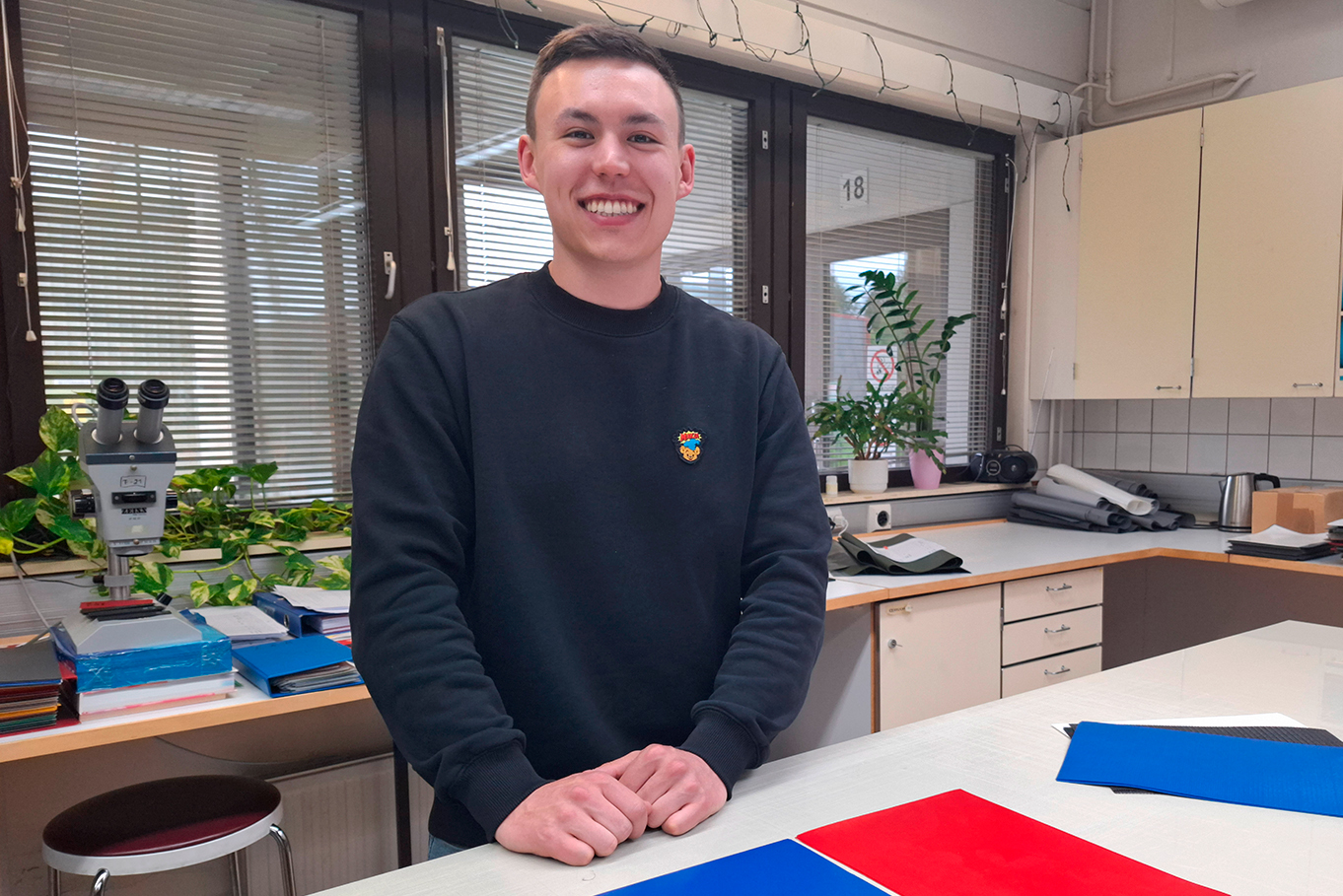
Every product starts with a customer need
A need for a new product rarely appears out of thin air. More often, the starting point is an existing fabric that works well but requires improvement in certain areas. That is where the journey toward a new, better-fitting solution begins.
– Often the customer already has a fabric in hand that they like. But when a specific detail isn’t quite right, we start adjusting the recipe of the coated fabric accordingly, says Eemeli.
What can be customized?
The recipe, manufacturing process and base fabric selection offer a wide range of ways to tailor a coated fabric. For example, we can customize following properties:
-
Surface feel and appearance – soft or firm, slippery or grippy, matte, glossy, or patterned. Multiple color options are available.
-
Workability – the choice of base fabric, along with the amount and composition of the coating mass, affects how the fabric bends, resists abrasion, and keeps its shape. A lacquered surface can also improve handling.
-
Performance requirements – resistance to chemicals, heat, fire, or weather can all be adjusted. Strength properties are optimized through the right choice of base fabric.
-
Lacquering and coating – for example, a single-sided fabric or lacquering applied only to one side may be the most cost-effective option. A lacquered surface also helps the fabric stay clean and makes it easier to maintain.
Product development is not only about adding new features but also about removing the ones the customer does not need.
– With the right recipe, we can add what is necessary and leave out what isn’t. This way the customer pays only for what they actually need, says Eemeli.
Testing ensures the quality
Once the first version of the fabric is ready, it is never left at the prototype stage. In addition to customer feedback, we test the fabric in our laboratory to verify the performance improvements are reflected on paper as well.
– It’s important that the benefits the customer experiences can also be confirmed through testing. That’s how we know the fabric performs both in practice and in measurable results, Eemeli explains.
In our in-house laboratory, we carry out various strength tests, verify the fabrics fire behaviour, test abrasion and flex resistance, and study material ageing in different climate chambers. We also examine how materials behave in both high and low temperatures. Our cold-testing equipment reaches as low as -80 ºC.
When a fabric must meet a specific standard or industry requirement, we work with the customer to select and accredited external laboratory suited to the end use. A typical example is materials used in the automotive industry, where extremely low emission levels are required for interior applications.
Product development is customer service
Responding to customer needs is important to us, and developing new products is a key part of our service. When the result of recipe development and pilot runs is a coated fabric that matches the customer’s expectations, we feel a strong sense of professional pride.
– The most rewarding part of this job is seeing a satisfied customer, Eemeli sums up.
Kommentit (0)