
The structure of coated fabric – Optimized for your application
Coated fabric consists of multiple layers, each with its own function. The structure of a coated fabric includes a base fabric, an undercoat, a coating layer (e.g. PVC, PVC/PU-blend or TPU), and a lacquer. For the fabric to perform optimally in its intended application, these layers must be carefully designed and manufactured.
The product manufacturing process goes through several stages, from identifying the end use to designing the formulation, selecting raw materials and the base fabric, and conducting trial runs and laboratory testing. The manufacture of coated fabric is a science in which every stage of the process and every raw material used plays a role in the performance of the final product.
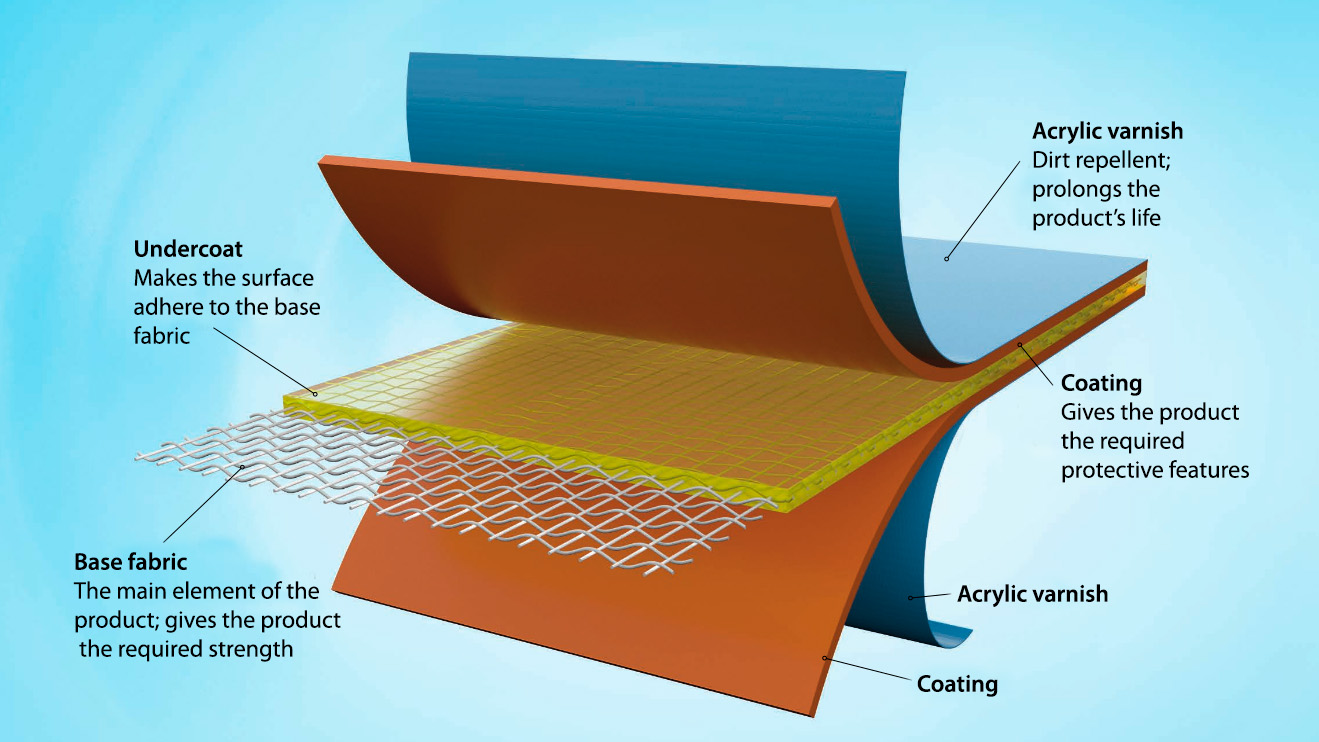
Base fabric is at the core of coated fabric
At the core of a coated fabric is knitted or woven base fabric, which provides the final product with its desired strength. It also influences the drape of the fabric and the handling characteristics of the product, such as stiffness and flexibility. In addition, the base fabric affects the appearance of the product, especially when the amount of coating is minimal. Scanplan-fabrics feature a knitted base fabric, while Vinyplan-products use a woven base fabric. The base fabric is always selected according to the application.
A knitted base fabric offers high tear resistance and good drape
A knitted base fabric is a good choice when the application requires high tear resistance. For example, in covers, protective sheets, nets, and curtains, this is important feature since the items are frequently moved or handled.
Knitted base fabric drapes well. The manufacturing technique of knitted base fabric allows for a more open fabric structure, which is why net materials are generally made using a knitted base fabric.
A woven base fabric provides high tensile strength and durability
Woven base fabric provides excellent durability and tensile strength. It is optimal for use especially in hall, boat, oil boom, and silo fabrics, as well as truck tarpaulins. In addition, woven base fabric is optimal for large and heavy doors due to its strength properties.
A woven base fabric generally provides a smoother surface in the final product. This is also influenced by the yarns used in the weave and the amount of twist applied to the yarns. The twist increases the strength and durability of the yarn.
Choosing the right PVC fabric for your application matters – Read more >>
Undercoat makes the surface adhere to the base fabric
The purpose of the undercoat is to create a bond between the coating and the base fabric. This is ensured by the adhesive agent contained in the undercoat. The undercoat formulation is designed to complement the properties of the coating.
If the coated fabric is designed to be UV- and fire-resistant, these properties must be considered when selecting the undercoat formulation. The desired low-temperature resistance of the final product also has a significant impact on the raw materials used in the undercoat.
Coating provides the fabric with desired protective properties
The coating is the outermost layer of the fabric before possible lacquer and provides the product with desired protective properties, complementing the undercoat. Protective properties include, among others, fire, UV, and mold resistance, as well as resistance to low temperature or oil.
The amount of coating also has a significant effect on the weight of the final product. As the amount of coating increases, the fabric’s weight increases, and its protective properties are enhanced. The amount of coating particularly affects the fabric’s weather resistance.
The fabric can be coated on one or both sides, depending on the application and the required properties of the fabric. We coat fabrics with PVC, PVC/PU-blends and TPU. During the coating process, the fabric also acquires the desired color through pigments added to the coating mixture.
Lacquering makes the fabric easier to handle and cleanse
To make handling and cleansing even easier and to extend the lifetime of the fabric, the surface of the fabric can be finished with a lacquer. Depending on your needs, you can choose between an acrylic-based or a PVDF-based lacquer.
Your partner for coated fabrics
We help you find the right PVC-coated fabric for manufacturing your end products and meeting the requirements of your applications. Contact us at sales@scantarp.fi and let’s discuss more!
Find the right coated fabric for your application >>
Kommentit (0)